A Library To Couple PyTorch ML Models With Fortran Climate Models

Senior Research Software Engineer
ICCS - Institute of Computing for Climate Science
University of Cambridge
2025-10-23
Weather and Climate Models
Large, complex, many-part systems.

Parameterisation
Subgrid processes are largest source of uncertainty

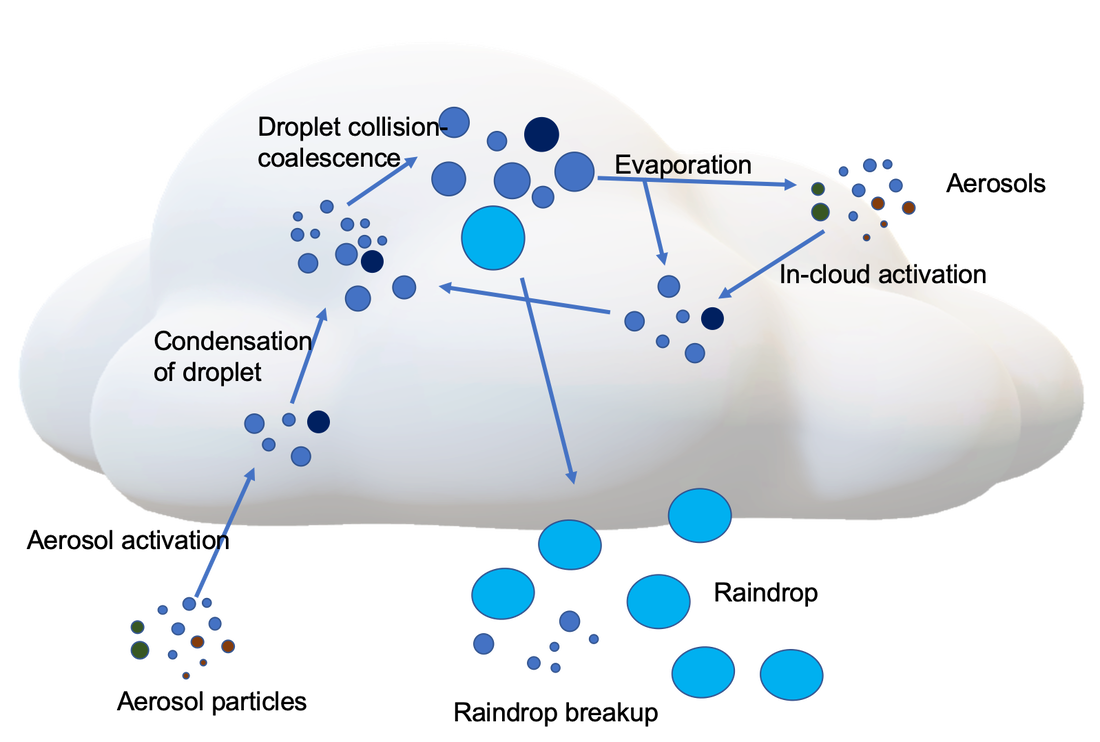
Microphysics by Sisi Chen Public Domain
Staggered grid by NOAA under Public Domain
Globe grid with box by Caltech under Fair use
Parameterisation
Subgrid processes are largest source of uncertainty
Microphysics by Sisi Chen Public Domain
Staggered grid by NOAA under Public Domain
Globe grid with box by Caltech under Fair use
Hybrid Modelling

Neural Net by 3Blue1Brown under fair dealing.
End-to-End

https://www.microsoft.com/en-us/research/project/aurora-forecasting/
Language interoperation
Many large scientific models are written in Fortran (or C, or C++), but machine learning is (mostly) conducted in Python.







Mathematical Bridge by cmglee used under CC BY-SA 3.0
PyTorch, the PyTorch logo and any related marks are trademarks of The Linux Foundation.”
Approach



Python
env
Python
runtime
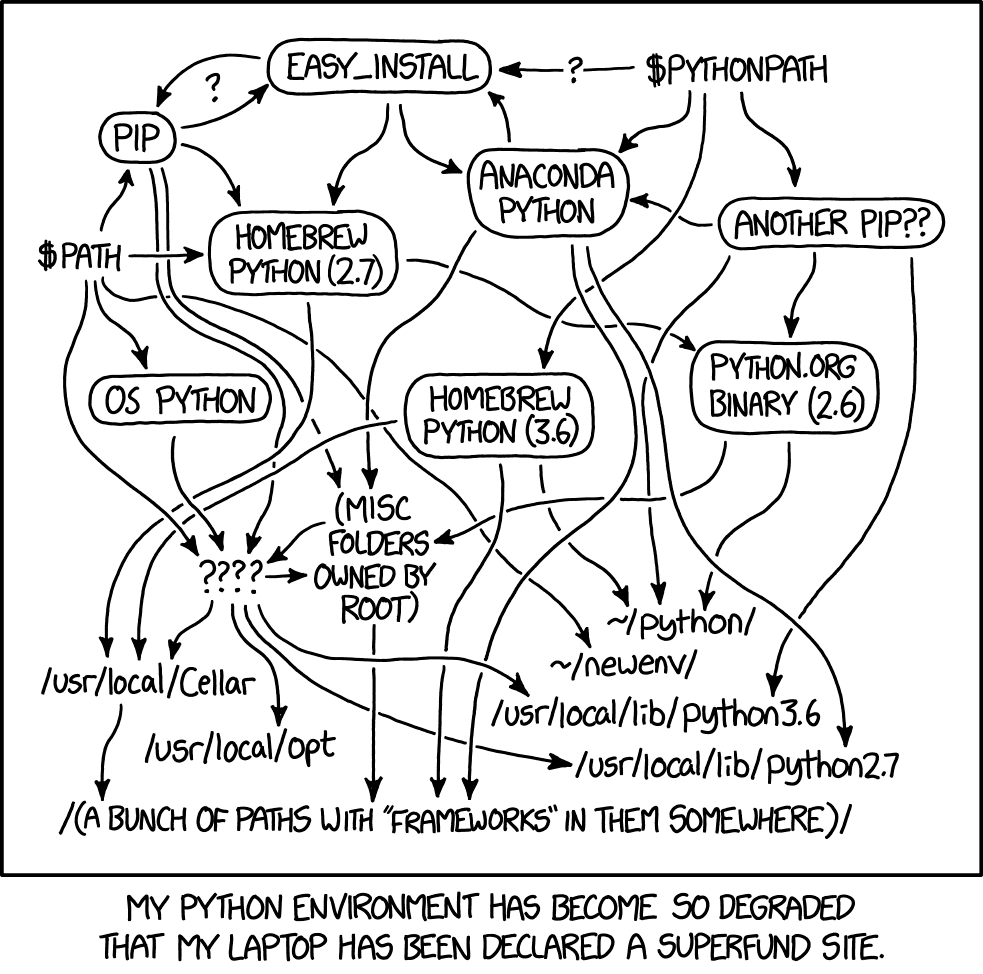
xkcd #1987 by Randall Munroe, used under CC BY-NC 2.5
Highlights - Computation
- Indexing issues and associated reshape1 avoided with Torch strided accessor.
- No-copy access in memory (on CPU).

Find it on :
Saving model from Python
import torch
import torchvision

# Load pre-trained model and put in eval mode
model = torchvision.models.resnet18(weights="IMAGENET1K_V1")
model.eval()

# Create dummmy input
dummy_input = torch.ones(1, 3, 224, 224)

# Save to TorchScript
if trace:
    ts_model = torch.jit.trace(model, dummy_input)
elif script:
    ts_model = torch.jit.script(model)
frozen_model = torch.jit.freeze(ts_model)
frozen_model.save("/path/to/saved_model.pt")
TorchScript
- Statically typed subset of Python
- Read by the Torch C++ interface (or any Torch API)
- Produces intermediate representation/graph of NN, including weights and biases
tracefor simple models,scriptmore generally- Soon to be deprecated - ExecuTorch?
Fortran
 use ftorch

 implicit none

 real, dimension(5), target :: in_data, out_data  ! Fortran data structures

 type(torch_tensor), dimension(1) :: input_tensors, output_tensors  ! Set up Torch data structures
 type(torch_model) :: torch_net
 integer, dimension(1) :: tensor_layout = [1]

 in_data = ...  ! Prepare data in Fortran

 ! Create Torch input/output tensors from the Fortran arrays
 call torch_tensor_from_array(input_tensors(1), in_data, torch_kCPU)
 call torch_tensor_from_array(output_tensors(1), out_data, torch_kCPU)

 call torch_model_load(torch_net, 'path/to/saved/model.pt', torch_kCPU)  ! Load ML model
 call torch_model_forward(torch_net, input_tensors, output_tensors)      ! Infer

 call further_code(out_data)  ! Use output data in Fortran immediately

 ! Cleanup
 call torch_delete(model)
 call torch_delete(in_tensors)
 call torch_delete(out_tensor)
Thanks for Listening
Get in touch:
Thanks to Jack Atkinson, Joe Wallwork, Tom Meltzer,
Elliott Kasoar, Niccolò Zanotti and the rest of the FTorch team.
The ICCS received support from 
FTorch has been supported by 


